Blog

  • Perspectives from the End of a Generation

    As a person born in 1980, I fall at the end of Generation X and the beginning of Generation Y or the Millennial Generation. This gives me a unique perspective on life that I’d like to share from my generation.

    Sometimes it can be fun to get a little perspective. Age gives us this view. Some of these are related to people you may not know, but I’ll try to keep it as relevant as possible.

    Famous Births

    Britney Spears, Justin Timberlake, Christina Aguilera, Beyonce Knowles, Kim Kardashian, and Paris Hilton are all around the same age as me (born either in 1980 or 1981).

    Space Travel

    The last time man left near-earth orbit was in 1972, 8 years before I were born, which was also the last time we landed on the moon during Apollo 17.

    The first time man left near-earth orbit was during Apollo 8 in 1968, 12 years before we were born and the first moon landing was a year later during Apollo 11.

    Civil Rights

    The American Civil War ended 115 years before I was born, but the Civil Rights Act was passed only 16 years before I was born in 1964.

    Brown vs. Board of Education was handed down 26 years before I was born, in 1954. If that seems like a long time, consider that I’m now 34 years old.

    Presidents

    In our lifetime we’ve lived through ~6 presidents (Carter, Reagan, Bush Sr, Clinton, Bush Jr, and Obama) over a span of 33 years.

    In the 33 years before we were born there were ~7 presidents (Truman, Eisenhower, Kennedy, Johnson, Nixon, Ford, and Carter).

    Leonardo Davinci and Michelangelo were to George Washington and Thomas Jefferson what George Washington and Thomas Jefferson are to me in regards to age and perspective.

    Technology

    The first nuclear test was 35 years before I was born in 1945, the same year WWII ended. The ENIAC was built a year later in 1946.

    In 1986, 6 years after I was born, Earth experienced both the Chernobyl and Challenger Disasters. 27 years later Columbia disintegrated in 2003.

    2 years before I was born, GPS was invented in 1978. 22 years later in the year 2000, President Clinton granted nonmilitary users access to an unscrambled GPS signal. 7 years after that the iPhone was released.

    Famous Deaths

    John Lennon died in December of 1980. Albert Einstein died in 1955, 25 years before we were born. Pablo Picasso died in 1973, 7 years before we were born.

    War

    5 years before we were born, the United States lost the Vietnam War (1975). 27 years before we were born, the Korean War ended (1953). 2015 is the same distance from 1980 as 1980 is from the end of World War II (1945).

    If you liked this, you might like BuzzFeed’s 7 Mind-Shattering Facts About Time that includes things like how Anne Frank, Martin Luther King Jr., and Barbara Walters were all born in the same year. How’s that for perspective?


    7 Mind-Shattering Facts About Time by buzzfeedvideo

    Update March 13, 2015 from Reddit

    What 2 famous people lived at the same time in history that people wouldn’t think were alive at the same time?

    • Tom Selleck, Bob Marley, Rod Stewart, Bubba Smith, Micky Dolenz, Eric Clapton, Mia Farrow, and Tony Dow were all alive at the same time as Adolf Hitler
    • Cleopatra and Julius Caesar
    • Picasso and JFK
    • Hitler and Einstein
    • Anne Frank and Martin Luther King Jr
    • Eminem and Elvis
    • Justin Bieber and Andre the Giant
    • Abe Lincoln and Charles Darwin
    • Bill Nye and Ken Ham
    • Abraham Lincoln and Karl Marx
    • Walt Disney and Adam Sandler
    • Mark Twain and Nikola Tesla
    • Salvador Dali and Walt Disney
  • Do You Like to Write?

    Did you know that some people make money writing books? There are many different types of books. Some are stories and some are full of facts. What matters is creating value for the reader.

    What is Value?

    If I am bored and want something to entertain me, and I read a story that entertains me, then that story has provided me with value. If I am searching for the answer to a problem and a book contains the answer to that problem, it has provided me with value.

    Value is different than money.

    Money is what someone is willing to pay for value, but they are not always equal. Oftentimes people are only willing to pay for something they perceive as being more valuable than the money they are paying for the thing. Let me give you an example.

    You need 4 quarters to park your car, but you only have dollars. While in the car you see a man walking down the street. You ask him if he has 4 quarters. He does, but he says he wants $2 for the 4 quarters. Or say the man says instead, “If you pay me $2 I will take your $1 to the bank 4 blocks away. I will run as fast as I can. And I will be right back.” Which offer do you think the person in the car thinks is more valuable? Both have the same result. Humans are not always rational.

    Here’s another example: a used baby doll is sold on the Internet at a place called eBay where you can sell anything you want. The doll sells for $1 on it’s own. But then the person who buys it writes a story about the doll and re-sells the item on eBay, this time with the story about the doll. The doll then sells for $50 because the buyer percieves the value of the doll as being more because of the story. This is another way to make money from writing.

    There are many ways to make money from writing. Some people write instructional courses to teach people. Some people write plays or movies or TV shows. Some people write jokes to tell people at comedy clubs or on late night TV. Some people even write legal briefings or report on news to tell people what happened at a particular event.

    I encourage you to keep writing and to keep learning the different ways you can make money – by writing – and other ways. Up next: How to Make Money.

  • The 100th Monkey Effect: How Ideas Tip

    The Office UK Monkey

    Back in 2009 I was listening to a Coast to Coast episode regarding “Mind Viruses & Genetics.” Author and speaker in the field of self-development, Dr. Wayne Dyer, and foremost authority in bridging science and spirit, Dr. Bruce Lipton, discussed how genes and DNA do not control our body, and how MEMES, or mind viruses, are infecting our population.

    Whether you believe that thoughts can interact with the universe, God, or control the cells of our own bodies is beyond the scope of this post, but I would simply like to point out some new terms I heard while listening to the episode. The first term is “phase transition,” which is a physics term for when electrons in an atom line up to cause a transition from one phase to another such as from a liquid to a gas. This tipping point happens when a set number of electrons line up, causing all the other electrons to follow, which changes the atom’s phase. The author called that point the “100th monkey.”

    According to Wikipedia, the Hundredth Monkey Effect is where, “a learned behavior spreads instantaneously from one group of monkeys to all related monkeys once a critical number is reached. By generalization it means the instantaneous, paranormal spreading of an idea or ability to the remainder of a population once a certain portion of that population has heard of the new idea or learned the new ability.”

    You may have heard of the physics term, “quantum entanglement” which is “a possible property of a quantum mechanical state of a system of two or more objects in which the quantum states of the constituting objects are linked together so that one object can no longer be adequately described without full mention of its counterpart — even though the individual objects may be spatially separated. This interconnection leads to non-classical correlations between observable physical properties of remote systems, often referred to as nonlocal correlations.”

    Along with doctors who noted that cells taken out of a body respond to stimuli from their original host, you get the gist that there may be undetectable ways that matter communicates at the quantum or atom level, the cellular level, and at the organizational level (as with the 100th monkeys effect). W. Edwards Deming, the engineer whose quality management systems transformed Japanese manufacturing, noted that if you get the first 15 percent of any system right, the other 85 percent flows easily.

    At first I thought this was like Pareto’s 80/20 rule, but now realize it is more like the tipping point or the 100th monkey effect. I’ve noticed in working with one of my clients that when we create a new system, such as a tracking sheet, once we get buy-in from a certain number of individuals, the success of that system grows from there. But that could be more of a network effect rather than a ‘100th monkey’ thing.

    The reason I wanted to mention all of this is because I have noticed lately the power of the individual. Anything that ever happens can be traced back to one person first having the idea – and then sharing it. Once shared with enough people to get critical mass, it tips, the electrons align, and the phase transitions. The point is, although things happen best within teams of at least two people, ideas begin with one. If you have an idea. Share it. Maybe know one else will ever have the same idea.

    If Tesla had kept alternating current to himself, we would all be using Edison’s direct current today. That’s just one example, but there are many. The hyperlinked web you are using right now was invented by one man, Tim Berners Lee. It’s not just inventions, its deciding to love someone. It’s whatever you can imagine. I encourage you all to imagine, to stretch your mind, and cast off feelings of doubt and self-sabotage. Tell yourself you can and you will.

    Transitions have that kind of split personality where a lot changes, but very little gets done sometimes. Even static people can do that to themselves when they spend all their time preparing and organizing and never taking action. A friend of mine once announced he’s going to get a divorce and moved out of his house. His productivity level plummeted. I think that sometimes growth comes from stability, other times it comes from an uprooting.

    Around the same time I was listening to 50 Prosperity Classics. Like Canfield, co-author of Chicken Soup books and others have suggested, we hung a note on our front door that has a dollar goal, a list of things we’d do or buy with the money (pay bills, carry cash in our pockets, be able to help others, go out to eat guilt-free, get a faster computing experience) as well as actual checks made out to us. In addition, I started speaking to myself things like, “I can be rich. I am rich. I can make [X] dollars a year. I do make [X] dollars a year.” and even “I can be a good father. I can love the Lord our God with all my heart, mind, and soul.”

    What I began to notice from that practice was that normal inputs like web design requests and computer repairs started hitting my sub-conscious mind differently. When they came in, my “gut” said, “You make [X] a year. You can’t be coding websites anymore. Hire someone to do that so you can multiply yourself and make more money in less time. You build businesses for other people to work in. That is what you do now.” Yeah, I know, my gut is long winded – its kind of like those Chinese translations on TV, satirized by Wayne’s World, only in reverse.

    In that radio show I listened to on Coast to Coast AM, one of the guys said that the sub-conscious or “habitual” mind as he called it makes up 95% of our behavior throughout the day and that much of what we do is automatic. Only 5% requires us having to think to make decisions. This means that we have a huge opportunity to manipulate this habitual mind to our liking and to our benefit. The more I read and listen, the more I find that most writers are all saying the same things. “Ask and it
    will be given,” and “Tell yourself you can and you will.”

  • All I Really Need to Know About Process Management I Learned Washing Dishes

    The first job I ever had was in during high school at a fancy restaurant called Heiskell’s Restaurant and Lounge. I washed dishes 3 nights a week (Thursday, Friday, and Saturday). Although I worked there with several of my friends, it was still one of the worst jobs of my life. For 3 years I traded my precious weekend evenings washing someone else’s good times down the drain, but it’s from this literal pit of despair that I learned all I really needed to know about business process management or BPM.

    Pots and Pans

    When you first show up to work, the prep team is just wrapping up and the wait staff have yet to arrive, but the pots and pans have already piled up. There’s a mound of crusted cheese and baked on food to work through before your first dish hits the Hobart. This is where you learn the first business process management task, Design. Before the night heats up, focus on the “work flow, the forces that act on it, interruptions, deadlines, procedures, service level agreements, and inputs and outputs.”

    “Good design reduces the number of problems,” for the rest of the night. “Whether or not existing processes are considered, the aim of this step is to ensure that a correct and efficient theoretical design is prepared.” The flow you develop washing the pots and pans, getting a feel for the water hose, dealing with interruptions from the chef, and preparing for deadlines (“We need more cups!”) will help you meet the service level agreements you and your business have made with the customer.

    Inputs and Outputs

    After the first orders come in, it’s only a matter of time before the dishes start to come back. First comes the bread and salad plates, then comes the dinner plates, followed by the cups. Wait staff will bring huge trays of dishes all at once and often times there will be several people trying to drop off a tray full of dirty dishes at once. This is where Modeling is learned. “Modeling takes the theoretical design and introduces combinations of variables to determine how the process might operate differently.”

    “What if the wait staff staggered their trips in and out of the kitchen? How would that affect the time spent dropping off dishes?” or “What if I anticipated the next tray of dishes by stacking dirty dishes to make room for more trays from the wait staff?” We call this process the Staffing Model or Utilization Model, depending on its use. “A Staffing Model is more of a predicting tool for management, whereas a Utilization Model is more of a reporting tool after-the-fact, but both are effective BPM tools.”

    Forks, Knives, and Spoons

    While plates stack nicely in a tray, silverware lay loose in a tray and need sorted after they come out of the washing machine. As a result of this process, silverware is saved up and ran only when the tray is full (or when we need more silverware washed to meet demand). This creates a “packet size problem”  that exists in everything from Internet traffic to Items Processing runs. In business process management, we call the study of figuring out the best way to do something, Optimization.

    “Process optimization includes retrieving process performance information from modeling or monitoring phase; identifying the potential or actual bottlenecks and the potential opportunities for cost savings or other improvements; and then, applying those enhancements in the design of the process.” Based on those inputs, “Recommendations will be made that overall creates greater business value.” Over time a dishwasher learns the optimal number of silverware per tray.

    We Need More Cups

    Cups, like silverware, run in batches, but there is a finite amount of cups that can be loaded per tray. This is where Monitoring comes into play. “Monitoring encompasses the tracking of individual processes, so that information on their state can be easily seen, and statistics on the performance of one or more processes can be provided. An example of the tracking is being able to determine the state of a customer order so that problems in its operation can be identified and corrected.”

    “The degree of monitoring depends on what information the business wants to evaluate and analyze and how business wants it to be monitored, in real-time, near real-time or ad-hoc. Here, business activity monitoring (BAM) extends and expands the monitoring tools in generally provided by BPM. Time studies can also depend on whether or not the business consultant is recording times as they are or as they should be,” which every dishwasher who’s ran a Hobart knows well.

    Kitchens are for Closers

    In the end, it’s all about Execution. “In practice BPM analysts rarely execute all the steps of the process accurately or completely. Another approach is to use a combination of hardware and human intervention, but this approach is more complex.” It doesn’t matter how good your procedure is, sometimes the silverware tray tips over in the bottom of the Hobart or the garbage disposal gets clogged. No matter what, you’re going to have to stick your hand down in a deep, disgusting, wet hole.

    “As a response to these problems, BPM processes have been developed that enables the full business process (as developed in the process design activity) to be defined in a way to improve business operations. Compared to either of the previous approaches, directly executing a process definition can be more straightforward and therefore easier to improve. However, automating a process definition requires flexible and comprehensive infrastructure,” which is something a dishwasher knows well.

  • My No-Code SaaS App: PrintMe

    What is your no-code SaaS app idea?

    Email me stuff you want archived (could be emails, pictures, or documents) and when your archive is ready to be printed (read: optimal page length reached), I’ll send you a Paypal link and have it shipped to your door. It will feature archive-rated, acid free, glossy paper and will be something you can put on your shelf as a paper-based archive for your most cherished emails (such as those from me or that first email between you and your spouse or child).

    How does it work?

    I get the emails and put the stuff in a book-making app. When the pages are full, I alert you that it’s ready to print, add a markup, get paid, and have it printed and shipped to you.

    What are some reasons why it might not work?

    People may be sensitive about sending their personal information to a person or service. Or the cost of markup may be higher than people are willing to spend for this “app”.

    Is there anyone else doing this?

    There is already apps that link to Facebook posts and Instagram pictures to allow those to be printed (they are consistent in size and shape, making it easier for apps to format). I also looked into Blog2Print and Blurb to print my blog.

    What problem are you trying to solve?

    I don’t have an easy way to take emails, blog posts, and Evernote notes and turn them into a printed, bound journal. In the past, I would keep paper journals. Now I keep that stuff digitally, but I still want to have a printed copy to put on my shelf to pass down to kids and protect from an electromagnetic pulse or some other catastrophic data loss or account lockout.

    Who would use a service like this?

    People born before 1990 who have children and a decent fear of loss of data coupled with a desire to leave a legacy (i.e. Scrapbookers, Baby book makers, Mothers, and Fathers).

    Why are you doing this?

    I’ve always wanted to be an archivist. You know this. But it’s also one of the 10 e-commerce ideas I had for 2015 (i.e. people are going to want to print more stuff to avoid The White Album Problem).

  • The Interactive Fiction SMS Text Based App I Never Built

    I wondered if I could build a SMS/text-based interactive fiction (IF) app. This is a story of how I researched the problem, but ultimately failed to actually execute on making one.

    I didn’t know what I was looking for or even if it existed, but I had the desire to play a game via SMS (simple message service) text message that would allow me to unravel a mystery – something that would tell me a story throughout the day as long as I kept interacting with it.

    I was influenced by early childhood memories of reading “choose your own adventure” books and playing point-and-click adventure games like Shadowgate. In both cases the choices you made in the game affect the outcome and this interactivity with the story intrigued me (Note: I’ve written about games like Shadowgate before).

    Cavern of the Evil Wizard

    I did searches for “SMS games” and “text message games”, but couldn’t find anything. I eventually started searching for “text based games” which led me to discover the term “interactive fiction“. I immediately recognized it as the type of games portrayed in Tom Hanks’ Big (Cavern of the Evil Wizard) and the original Leisure Suit Larry.

    A friend of mine had the 1987 MS-DOS game, Leisure Suit Larry in the Land of the Lounge Lizards and we would have to hide from his parents to play the game. In the game, Larry is controlled by a text parser that can interpret typed commands like “talk to woman”. You never knew exactly what to say or how the game would react.

    It seemed the interactive fiction community was quite small by Internet standards as I kept running across one name: Andrew Plotkin, who also goes by Zarf. That lead me to download some IF apps on the iPhone and learn about some apps you can use to create your own IF games.

    I looked into Twillio for the SMS gateway, but eventually I learned enough to realize I didn’t really want to make my own IF game. Sometimes I do that. I think I want to do something, like making furniture, designing an app, or designing games, and then once I know how, I stop. That happens sometimes.

    Interactive Fiction Resources

  • Building the LongView

    In the spring of 2005 I ran an Indianapolis Game Development meetup called Indy Game Dev. It had one other member. We decided we’d make our own computer game.

    Indy Game Dev Members

    We met at his parent’s house in Fishers where he lived. His family computer was in his parent’s bedroom. I was still working at Old National, 2nd shift, down by the Indianapolis Airport, so it was always late at night when we met.

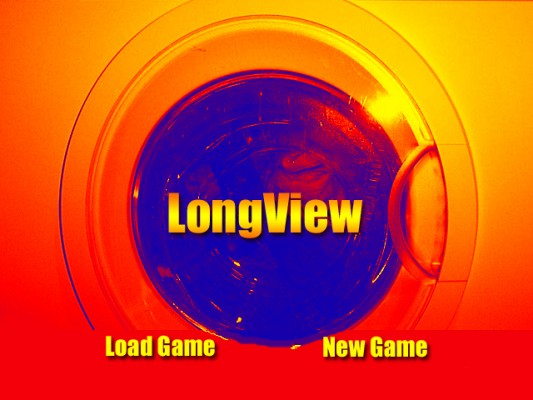
    Longview Start Menu

    The game was a turn-based game that worked similarly to how Shadowgate worked. It started you off in a room with a couple of options. The scenes were post-modern, urban decayed scenes with relatively little to no characters.

    LongView level One

    We mapped out the first level in a rudimentary drawing. It was a simple layout with a couple of different options. The same game could have been played easily without graphics in a ‘Interactive Fiction’-type game.

    LongView hallWay

    I had just graduated from Indiana University in Indianapolis the year before where I had taken Visual Basic.NET, Javascript, VRML, and HTML classes. In one of my classes I had made several browser-based games. I felt pretty confident.

    LongView attack Mode

    Right around this same time, Meetup.com decided to start charging for running a meetup. I understood, but it was a little more than I wanted to take on financially at the moment so I turned the meetup over to the other guy and left.

    The End of the Line

    I learned just enough about game design and 3D engines to discover I didn’t really want to design my own game. I guess I wanted to design a game, but really only wanted to know how it was done. Now I know.

  • A Letter to Chris after Leaving First Merchants

    9-11-2011

    Things have been a little rough lately, but life doesn’t stop throwing you curve balls just because you change careers. Rather than focusing on the negatives though, which is easy to do, I’d rather tell you about the good things that have happened and what I hope will happen in the future. I have started reading Proverbs in an effort to read one chapter per day. I can say that I have done that so far and began reading a little ahead each day so that on the 11th I’m actually around 14.5. I didn’t realize there was so much business advice in Proverbs, or at least that is how I am viewing it in my current mindset. “A little sleep, a little slumber, a little folding of the hands to rest—and poverty will come on you like a bandit and scarcity like an armed man” says Proverbs 24:33-34. This view of doing nothing leading to poverty and being diligent leading to success and riches is repeated over and over in Proverbs. Another theme is righteousness and integrity. “The integrity of the upright guides them, but the unfaithful are destroyed by their duplicity,” says Proverbs 11:3. Be one man. Be a righteous man. Be a diligent man. And you will be rewarded for it on earth and in heaven – these are the themes I’m picking up from Proverbs. Solomon, who wrote most of them was very rich and successful, and very wise. Proverbs says to seek wisdom, listen to your parents (who I view as both the actual parents, a metaphor for our leaders, and our heavenly Father), and the word (God’s commandments). There have been times since I have been reading that I have been in situations where I will look upon another woman and think about her as a path to sheol or wanting to bait me with her honey and lead me to death. There have been times when I’ve been tempted to be a different man when I’m alone than when I am with others. And other times when I have been quick to anger. Filling my mind with these proverbs is like a hand on my shoulder throughout the day.

    I don’t know exactly what to do or focus on in my business. I have somewhat condensed my two target customers to web design/social media management (Telablue) and computer repair/mobile phone support (Geek Hand), but have had no new customers with each yet. Thankfully, some customers have increased their use of me, but I’ll need more in order to continue along this path. The strange thing is if you asked me what I wanted to be doing (to make money) I wouldn’t have an answer. I am simply doing what has worked in the past. And from the client’s perspective, I haven’t really identified exactly what they are most frustrated with and what they are hiring me for (so that I can do more of this for them and others).

    Three days ago I watched a documentary called Fat, Sick, and Nearly Dead about a guy who does a juice fast for 60 days. I did it for 2 days (Thursday and Friday) and it was really gross. I lost some pounds and had a clear head, but it made me sort of sick of food (like get sick at the smell of food) so I stopped it. I’ve taken today to rest and think about things. Tomorrow is kind of a big day for me in small ways. I got out of my lease at my office in Tipton and the landlord lady (who locked me out after being late on rent) is letting me in to get my computer. It’s going to be really embarrassing. Things like that make me feel bad, but I guess I should be glad that I learned from the experience and am saving $600 on future rent. The weird thing is that part of the reason I leased it was to be able to use it during the Pork Festival, but that was the very time when I was locked out.

    I’m sure you’ve heard about God opening and closing doors or using green lights and red lights. I’ve had what seems like several doors close or red lights to things in my life in the last month: My app developer didn’t want to work with me any more and sent my money back. There’s the office thing. The guy I was working with to start a seminar/training business stopped talking to me. I told my parents we couldn’t go to Missouri to see my grandma’s funeral after several unexpected expenses came up. Although I had two interviews with ExactTarget, they didn’t call me back. My $200+ a month blog, Nook Share, started paying out less than $10. Those are the door closings. The open doors: I wrote a book and published it on Amazon. I hired (I’m paying him with experience and food) an intern who I’m training to help me out and learn what I do, which is what Michael Hyatt talked about today (building a team). I attended a two-day blogging conference on a client’s dime. I found a BNI group to attend in Carmel this Thursday and a networking Meetup to attend in Carmel tomorrow. I attended a LinkingIndiana event in Indianapolis where I met several people. My intern passed out Geek Hand flyers at the Pork Festival and I got to ride in the parade with my daughter, who won the mini-4H princess contest.

    If you put the door closes on a scale against the door openings you’d probably have a lot of lost income on the door closings and a bunch of hope on the door openings, but it is what it is for now. I’m still me – a smart guy with a lot of potential. I’m just trying to figure out how to transfer that into a form that other people can recognize.

    Have a good week!

  • The Story of Us

    I started out in Kansas City on the east side of the Missouri where I grew till I was eight and in not so much a hurry
    My wife had just turned six when I moved out to Indiana
    Born and raised a Tiptonite she was a little bannana’s

    When I was twelve I moved down to different piece of the American pie
    And my wife’s dad moved up to his own real estate in the sky
    We both it was rough and we had to adjust, but for her it was harder
    She had lost her friend, her soulmate, her one and only father

    For a while there it seemed like all my girlfriends were forty-five minutes away
    And I was driving out on the road for over and hour and a half a day
    Just to get the chance to have a dance with a philly from the Net
    Never knowing that the girl this time was my wife whom I had met

    11/27/09

    When first we met in July of 2001 I was mowing grass for $7.00 an hour after having received a 50 cent raise for doing good work. A week earlier I had been hired on at Old National Bank after convincing the interviewer, Corey Jennings, that while I was not currently a fast keyer, I did prefer to use the 10-key and I could improve. I did improve and continued to earn $7.47 an hour keying. As my relationship with you progressed I realized I was falling in love with you. From the very first night I knew you, I knew that I had found my wife. Then I re-entered school for my first and only semester at Ball State after attending Kentucky Christian College for two years and spending one semester at Milligan College in Tennessee. By September of that year you had accepted my proposal for marriage after which you asked me to ask your mother for permission. I remember asking her at the bottom of the steps in what is now our house. She cried and said, “Yes.”

    By October, the mowing season was coming to an end and I quit mowing. My boss at Clean Cut, Troy Harshman was so pleased with my work, he offered me $7.50 an hour to stay, but I felt I could not continue to work two jobs and go to school. However, by November I was offered a job cleaning a hotel so again I began working a second job, this time earning $5.50 an hour. That Thanksgiving was the first Thanksgiving I spent with your family and I remember showing up late after having cleaned people’s hotel rooms all morning. I continued to work at the hotel through Christmas, but when Old National moved to Indianapolis, I was promoted to Balance Controller, earning $10.25 an hour. I quit the hotel and transferred from Ball State to IUPUI. You were still attending Depauw University. I would visit you on the weekends and you would visit me some nights at work. One of my fondest memories is the weekend trip we took together to Terre Haute.

    I was still at Old National in August of 2002 when we got married and I stayed at Old National through the birth of our first child, Magdalena in 2004 and our second child, Carmina in 2006. I graduated from IU in August of 2004 at which point I began working a second job with Neighborhood Geeks. I continued to earn raises at Old National until eventually choosing to go back to school in 2006 after reaching $13.50 an hour. In June of 2007 I decided to become Microsoft Certified and begin a career in the IT field, both of which I accomplished in four months. Although I worked temporarily at two call centers, I was in school and working for my parents landscaping business to make ends meet until October of 2007 when I began working for AllThingsIT for $20 an hour. That same month I started my own business to help people market their services online, which provided a steady source of income in 2009. In June of 2008 I left AllThingsIT to begin working for First Merchants Corporation for $20 an hour.

    When you told me about the finances this past summer, I didn’t get mad. I didn’t leave you. I stuck with you. I worked harder, but the harder I worked, the less time I had to spend with you. And the harder I worked, the more angry I got when things like the laundry didn’t get done. When I found out what you had been doing at the turn of this month I was slow to anger and quick to forgive, but when I saw your lack of a contrite heart and a failure to reconcile with me, I found it unbearable to be around you. I kept bringing up the past and you retaliated with bringing up more of my past. All of a sudden I was someone who had been mean to you our entire marriage, I was someone who was always trying to leave. All of a sudden I was someone who never wanted to be with you. This is the same guy who has worked two jobs for you and our family for 8 years. This is the same guy who has married you twice, who swore he would take care of you no matter what. Yes, I left, but I came back. I was willing to work things out and I still am. I love you. End of story.