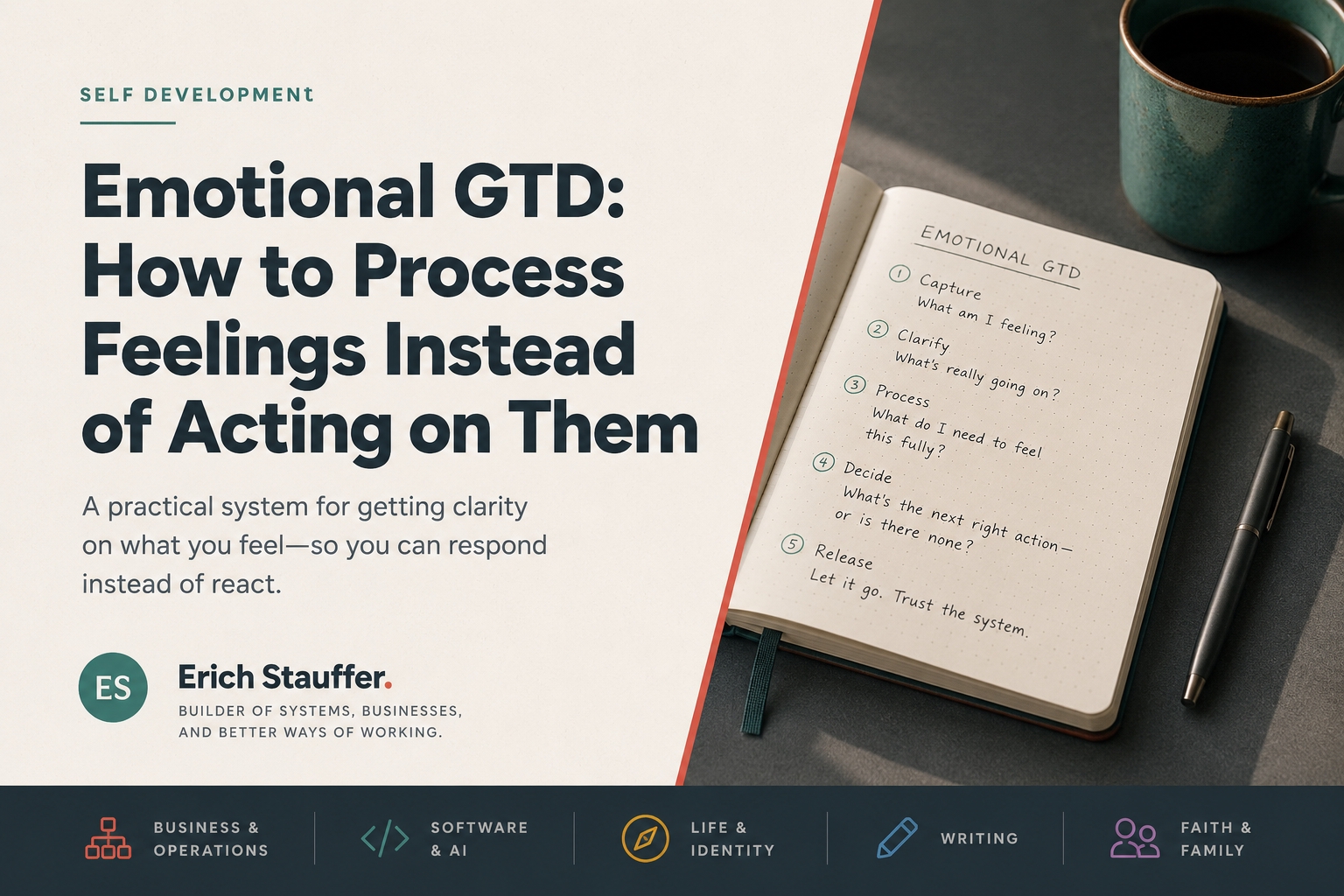
One of the most helpful insights I’ve had recently is that emotional maturity is a lot like Getting Things Done.
In GTD, David Allen teaches that your mind is not for holding vague, unresolved inputs. Your mind is for having ideas, not storing stress. So you capture what is on your mind, clarify what it is, organize it into the right place, and then decide what, if anything, needs to be done.
I realized emotions work the same way.
For much of my life, I did not know how to process emotions. I did not have the vocabulary. I did not have the categories. I had feelings, impulses, longings, fears, griefs, attractions, disappointments, and hopes running through me, but I did not know how to sort them.
So they all went into giant buckets.
“I feel bad.”
“I want her.”
“I’m angry.”
“I’m rejected.”
“I need to do something.”
Those buckets were too big.
And when your emotional buckets are too big, you cannot process what you are actually experiencing. You either suppress it, act on it, overthink it, fantasize about it, spiritualize it, or try to solve it immediately.
But not every feeling is a command.
Some feelings are just inbox items.
Feelings Are Inputs, Not Orders
Let’s say I see an attractive woman.
The old route might have been:
Attraction → fantasy → lust → emotional escape.
But recently I started practicing a different route:
Attraction → awareness → classification → respect → release.
Instead of immediately imagining being with her, I pause and ask, “What am I actually feeling?”
That question matters.
Because attraction is not one thing. It is a bundle.
Attraction might include physical desire. It might include appreciation. It might include curiosity. It might include longing. It might include loneliness. It might include grief. It might include hope. It might include a nervous-system response that feels like urgency, even when nothing actually needs to happen.
When I only had one bucket called “I want her,” everything went there.
But “I want her” might actually mean:
- I notice beauty.
- I admire her discipline.
- I am curious about who she is.
- I want to be chosen.
- I want a wife.
- I want closeness.
- I feel lonely.
- I feel physically attracted.
- I am projecting a future onto someone I do not know.
- I am looking for emotional relief.
Those are not the same thing.
And because they are not the same thing, they do not require the same response.
Emotional Granularity Is Emotional Maturity
A person with poor emotional granularity has only a few labels:
“I’m mad.”
“I’m sad.”
“I’m attracted.”
“I’m stressed.”
“I’m fine.”
But a person with growing emotional maturity learns to say:
“This is disappointment.”
“This is grief.”
“This is longing.”
“This is lust.”
“This is admiration.”
“This is curiosity.”
“This is fear.”
“This is shame.”
“This is loneliness.”
“This is appreciation.”
“This is attachment.”
“This is hope.”
That precision changes everything.
Because once you accurately name the feeling, you are no longer trapped inside it. You can relate to it. You can bring it before God. You can decide what kind of response fits reality.
If it is lust, I need to interrupt it and stop using someone’s image for my own gratification.
If it is appreciation, I can simply say, “That is beautiful,” and release it.
If it is curiosity, I can notice that I am drawn to someone without needing to build a whole future in my mind.
If it is longing, I can feel the ache instead of trying to medicate it with fantasy.
If it is loneliness, I can care for my heart without assigning a stranger the job of saving me.
If it is grief, I can let myself mourn without turning the pain into a mission.
The Emotional Inbox
This is where the GTD analogy becomes useful.
In GTD, an input lands in your inbox. You do not immediately act on every input. First, you clarify what it is.
Is it actionable?
Is it reference material?
Is it trash?
Is it someday/maybe?
Is it waiting for someone else?
Is there a next action?
Emotions can be processed in a similar way.
“I saw a beautiful woman” is an inbox item.
Then I clarify:
What kind of attraction is this?
Is it appreciation?
Is it physical desire?
Is it curiosity?
Is it longing?
Is it loneliness?
Is it lust?
Is it grief?
Is it fantasy trying to start?
Then I organize it.
Appreciation goes in the “bless and release” bucket.
Lust goes in the “interrupt and do not feed” bucket.
Longing goes in the “feel this with God” bucket.
Loneliness goes in the “care for myself and reconnect with real life” bucket.
Curiosity goes in the “notice without forcing action” bucket.
Grief goes in the “make room to mourn” bucket.
Hope goes in the “hold lightly” bucket.
Not everything requires a next action.
That sentence alone is freeing.
Why the Buckets Matter
I have noticed that when my categories are too broad, my reactions become too intense.
This has been true not only with emotions, but also with relationships.
For example, if the only categories I have for women are “friend” and “wife,” then every interesting woman becomes overcharged. If I enjoy her presence, if she is kind, if she is beautiful, if she is spiritually thoughtful, if she laughs at something I say, if there is a spark of curiosity, my mind tries to file her under “potential wife.”
That puts too much pressure on the moment.
It puts too much pressure on her.
It puts too much pressure on me.
A better filing system has more categories:
- acquaintance
- friendly person
- woman I admire
- woman I am physically attracted to
- woman I am curious about
- woman I enjoy but should not pursue
- woman who is emotionally unavailable
- woman who is spiritually aligned but not relationally available
- woman I could intentionally ask out
- woman I am actively dating
- woman I am discerning for marriage
That gives reality more places to go.
And when reality has more places to go, I do not have to force every meaningful interaction into a marriage narrative.
The same thing is true emotionally.
If every ache becomes “I need a woman,” then I will use women as emotional containers for things that need to be processed elsewhere.
Maybe I do not need a woman in that moment.
Maybe I need to feel grief.
Maybe I need to pray.
Maybe I need to go for a walk.
Maybe I need to sleep.
Maybe I need to acknowledge loneliness without panicking.
Maybe I need to create something.
Maybe I need to remember that desire is not an emergency.
Desire Is Not the Enemy
None of this means desire is bad.
Desire is part of being human.
Attraction is not automatically lust. Longing is not automatically weakness. Appreciation is not automatically obsession. Curiosity is not automatically a calling to pursue someone.
The problem is not that I feel.
The problem is when I do not know what I am feeling, so I let the feeling drive.
That is where fantasy, impulsivity, rumination, and emotional overreach come in.
A mature response is not suppression.
A mature response sounds more like this:
“I feel attraction.”
“My body is awake.”
“My heart feels longing.”
“My mind wants to create a story.”
“She is a person, not a solution.”
“This feeling does not require immediate action.”
“I can bring this to God.”
“I can bless and release.”
That is not passivity. That is self-leadership.
Learning What I Was Never Taught
Some people grow up in homes where emotions are named, welcomed, and guided.
Others grow up in homes where emotions are ignored, mocked, punished, stifled, or treated as inconvenient.
If you were never taught how to process emotion, you may think the problem is that you feel too much.
But maybe the real problem is that you were never given enough categories.
You were handed a junk drawer and told to keep the room clean.
So now the work is not merely to “control your emotions.”
The work is to learn how to identify them, classify them, feel them, and respond wisely.
That is emotional stewardship.
That is emotional GTD.
A Simple Practice
The next time you feel something strong, try this:
- Pause.
- Name the broad category: “I feel attraction,” “I feel anger,” “I feel sadness,” “I feel fear.”
- Get more precise: “This is longing,” “This is disappointment,” “This is loneliness,” “This is appreciation,” “This is lust,” “This is grief.”
- Ask what it is asking for.
- Ask whether it requires action.
- If it does not require action, feel it without obeying it.
- Bring it to God.
- Return to your life.
That is the practice.
Not every feeling needs to be solved.
Not every attraction needs to become a fantasy.
Not every longing needs to become a plan.
Not every ache needs to become a text message.
Not every beautiful thing needs to be possessed.
Sometimes the faithful response is simply:
“I see what this is. I feel it. I honor what is true. I release what is not mine. I return to God and to the life in front of me.”
Final Thought
Emotional maturity is not becoming less emotional.
It is becoming more precise.
It is learning to say, “This is what I am feeling. This is what it means. This is what it does not mean. This is what I will do with it.”
That precision creates freedom.
Because once a feeling has been named, it does not have to rule you.
And once an emotion has been placed in the right bucket, your soul can stop treating every internal signal like an emergency.