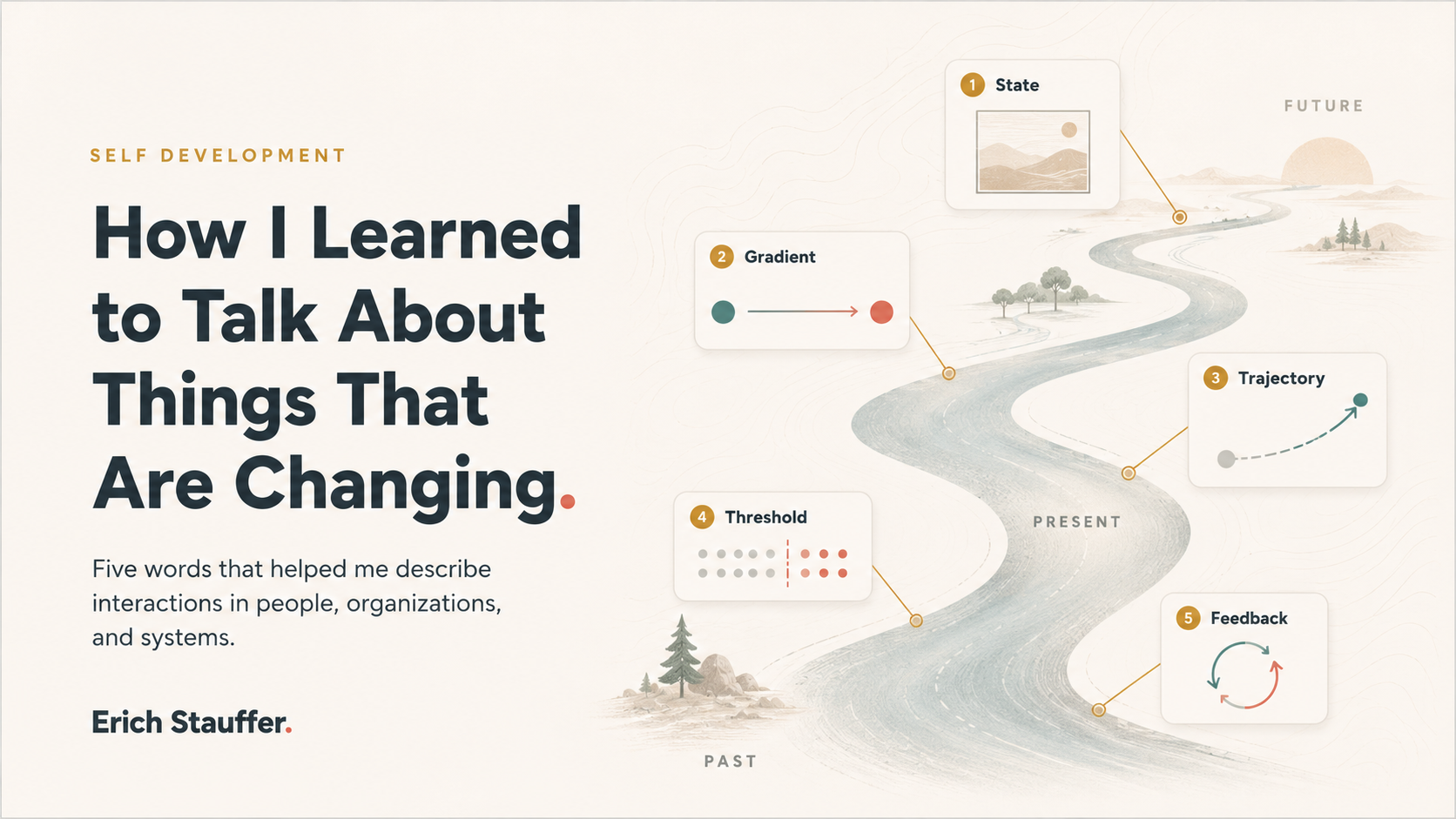
Five words that helped me describe interactions in people, organizations, and systems
I have a recurring communication problem.
Someone asks me a perfectly reasonable question about a software platform, an organization, a relationship, or a project, and I find myself struggling to give them a simple answer.
It is not usually because I do not understand the subject.
It is because the thing they are asking me about has been actively changing.
They may be asking about what the software was three months ago. I am thinking about what it does today. Someone else in the conversation may be thinking about where we expect it to be three months from now.
All three of us can use the same noun while talking about three substantially different things.
For years, my solution has been to draw diagrams.
I will divide a page into:
Past → Present → Future
Or I will draw something like a number line and point to different positions on it.
Or I will reach for the old idea that you cannot step into the same river twice. The river has the same name, but both the water and the person standing in it have changed.
Those metaphors work, but I have increasingly realized that I was compensating for something.
I did not have enough language for things that move.
We have excellent nouns for objects:
A person.
A company.
A software platform.
A team.
A marriage.
A project.
But nouns make things sound stationary.
What I needed were words for some of the invisible things happening between objects and across time.
Over the last several years—and especially through my work thinking about organizations, technology, relationships, and decision-making—I have gradually started collecting those words.
Five have become particularly useful:
State → Gradient → Trajectory → Threshold → Feedback
Together, they give me a much better vocabulary for talking about changing systems.

And, perhaps more importantly, they give me a better way to figure out what another person needs to hear before we can reason about the same thing.

1. State: What condition is the thing actually in?
The first word is state.
A state is simply the condition of a system at a particular moment.
Imagine someone asks:
What does your company’s internal platform do?
That sounds like a straightforward question.
But the answer might be very different depending on whether we mean:
Past: a few experimental capabilities built by individuals.
Present: a unified platform with teams, memory, analytics, and workflow functionality.
Future: a system that creates work automatically, interacts with outside systems, and handles increasingly complex operations.
Those are all descriptions of the same platform.
But they describe different states.
That distinction sounds obvious once it is stated, but I find that a surprising number of communication problems begin because two people are discussing different states without realizing it.
One person says:
“It doesn’t do X.”
Another person says:
“Yes, it does.”
They may both be correct.
One is describing the system they last encountered.
The other is describing its current state.
This has given me a useful question:
Which state of the system are we talking about?
A snapshot tells me where something is.
But a snapshot does not tell me what the thing is doing.
For that, I need another word.

2. Gradient: What important difference exists?
The word that recently unlocked a new way of thinking for me was gradient.
I originally started thinking about gradients in the physical sense.
Hot and cold.
High pressure and low pressure.
High concentration and low concentration.
Positive and negative electrical potential.
In each case, the difference between two states matters.
It creates the potential for something to happen.
Heat flows.
Pressure equalizes.
Particles diffuse.
Current moves.
The important thing is that the two objects are not the entire system.
There is also something meaningful about the difference between them.
That difference can be modeled.
And once I saw that, I started seeing gradients everywhere.
There can be a gradient between:
what a system currently does
and
what we want it to do.
There can be a gradient between:
what I understand
and
what you understand.
There can be a gradient between:
how one person feels about a relationship
and
how the other person feels about it.
There can even be a gradient between:
the behavior an organization currently rewards
and
the behavior its leaders say they want.
The objects matter.
But so does the space between the objects.
That space is not necessarily empty.
It can contain tension, potential, information, misunderstanding, attraction, conflict, pressure, or opportunity.
Once I had a word for that, I could begin drawing it.
Instead of:
A — B
I could think:
A — gradient — B
That is a small change in notation, but a large change in perception.
Something that had previously been invisible became a first-class part of the model.

3. Trajectory: Where is it going?
The next word is trajectory.
This is the word I wish I had more often when I find myself saying:
“It’s kind of like calculus.”
What I am usually trying to communicate is that knowing the current position of something is not enough.
Imagine two companies.
Company A has a score of 40.
Company B has a score of 60.
If those are the only numbers I give you, B appears healthier.
But now imagine this:
Company A: 20 → 30 → 40 → 55
Company B: 90 → 80 → 70 → 60
Now 40 and 60 mean something very different.
One system is improving rapidly.
The other is deteriorating.
Position without direction can be misleading.
Trajectory describes how the state of a system is changing through time.
That gives me much better language in conversations.
Instead of saying:
“Yes, but you have to understand that the system keeps changing…”
I can say:
“That’s its current state, but look at its trajectory.”
That sentence compresses a much larger explanation.
This is also where some earlier thinking I had about tempo and velocity fits into the model.
I had noticed that many disagreements are not only disagreements about what is happening.
They are disagreements about how quickly it is happening.
A relationship can progress too quickly.
Or too slowly.
A machine moving near a human can move so slowly that it feels unnatural, or so quickly that it feels threatening.
A policy can be less controversial in its goal than in the speed and intensity with which it is implemented.
Tempo and velocity were useful to me because they made another invisible property visible:
rate.
Gradient and velocity are not the same thing.
A gradient describes an important difference.
Velocity describes the rate and direction of change.
Tempo describes the cadence at which interactions occur.
Trajectory describes the path the system is taking over time.
Together, they allow a much richer conversation than simply asking whether something is “good” or “bad,” “working” or “not working,” “here” or “there.”

4. Threshold: When does gradual change become something different?
Then there is threshold.
This may be the concept that explains some of the most confusing events in life.
Something appears stable.
Nothing happens.
Nothing happens.
Nothing happens.
And then suddenly everything changes.
An object sits near the edge of a surface for hours and eventually falls.
A business model works until it doesn’t.
A technology seems niche and then suddenly becomes normal.
A relationship appears intact and then ends.
An informal behavior inside a company suddenly becomes official policy.
We tend to focus on the visible event because that is when we notice the change.
But often the visible event is not when the change began.
It is when the system crossed a threshold.
Years ago, I started calling something I noticed the 5% Rule.
I had seen examples where relatively small adoption of a new technology or behavior seemed capable of producing much larger changes in an industry.
At the time, I focused on the percentage.
Now I think the deeper idea was the threshold.
There probably is not a universal 5% rule.
Different systems have different tipping points.
The more durable idea is:
A small amount of continuous change can eventually create a discontinuous outcome.
Relationships provide an especially intuitive example.
Dr. John Gottman’s work observing couples became famous in part because recurring interaction patterns could be associated with very different relationship outcomes.
The interesting idea for me is not merely that one person changes and another person changes.
The relationship between them has a state too.
There is:
Person A
Person B
and
A ↔ B
Trust can change.
Respect can change.
Resentment can accumulate.
Positive interactions can reinforce connection.
Negative patterns can reinforce separation.
The people are changing.
And the third thing—the relationship—is changing too.
Eventually a system can cross a threshold where the visible label changes:
trust → distrust
cooperation → avoidance
married → separated
The final event may look sudden.
The trajectory that produced it may have been running for years.
That distinction has become extremely useful to me.
The event is not always the change. Sometimes the event is merely evidence that an earlier change finally crossed a threshold.

5. Feedback: What does the changed system do next?
The fifth word is feedback.
This closes the loop.
A system changes.
That change affects its environment.
The changed environment then affects the system.
And the process repeats.
I have experienced this repeatedly in organizations.
I notice a problem.
I start doing something differently.
I encourage a few other people to try it.
If the behavior works, I promote it.
I tell stories about the people doing it well.
Other people adopt it.
Eventually enough people behave that way that the organization notices.
Someone formalizes it.
Now there is a process.
Then governance forms around the process.
And eventually the process comes back and constrains me too.
The sequence looks something like this:
Idea
→ behavior
→ propagation
→ norm
→ process
→ institution
→ governance
→ feedback
The intervention changed the system.
Then the changed system became part of the environment acting back on the person who initiated the intervention.
That is feedback.
It also explains why systems rarely move in perfectly straight lines.
Every change creates new information.
That information affects the next action.
The next action changes the state again.
A dynamic system continuously reacts to itself.
Communication is itself a gradient problem
Once I started thinking this way, I realized something else.
When I am explaining a changing system to another person, I am actually trying to model two systems at once.
There is the subject itself:
- What state is it in?
- What is its trajectory?
- What important gradients exist?
- What thresholds are approaching?
But there is also the person I am talking to:
- What state do they think the system is in?
- When did they last interact with it?
- What assumptions are they carrying?
- What do they think is changing?
- What question are they really trying to answer?
The difference between our models is itself a gradient.
So when someone asks me a question, my brain is often doing something like this:
1. What state is the system actually in?
2. What state does this person believe the system is in?
3. What is the important gradient between those two models?
4. What information would reduce that gradient enough for us to reason about the same thing?
That last phrase—enough for us to reason about the same thing—matters.
I do not necessarily need to transfer everything I know.
The goal is not total informational equilibrium.
The goal is to reduce the relevant gradient enough that the next conversation can occur.
Sometimes that means answering the question.
Sometimes it means realizing that answering the literal question would be useless because the person is operating from an outdated model.
The first job is model synchronization.
Only then can the conversation move.
The invisible dimensions are often where the real action is
This is part of a broader pattern in my thinking.
I keep discovering dimensions that were already affecting systems before I had language for them.
Tempo was affecting interactions before I named tempo.
Velocity was affecting outcomes before I thought to measure velocity.
Gradients were creating potential before I started drawing gradients.
Thresholds were being crossed before I learned to look for thresholds.
Feedback loops were shaping my behavior before I explicitly modeled feedback.
Naming these things does not create them.
It gives me handles for them.
Language makes invisible structure cognitively manipulable.
That is one reason I increasingly think about words as a kind of software for the mind.
A good word is a compressed container of meaning.
Once someone understands the word gradient, I can ask:
“What’s the gradient here?”
That short question can unpack into a much larger reasoning process.
Where are the differentiated states?
What potential does their difference create?
Can something flow between them?
Are they converging or diverging?
What structure sits between them?
Is the difference approaching a threshold?
I do not have to rebuild the entire conceptual model every time.
The word executes it.
Structure turns gradients into direction
This also connects with Robert Fritz’s work on structural tension.
One of his central ideas is that there is power in holding two realities clearly:
current reality
and
the result you want to create.
The difference creates tension.
In the language I am using here, it creates a gradient.
But a gradient alone does not guarantee a desired outcome.
The structure surrounding it matters.
If I want water to move somewhere, I can build channels.
If I want an organization to behave differently, I can change incentives, information flows, permissions, workflows, and norms.
If I want a person to move toward a goal, I can change the environment in which decisions are made.
The goal is not always to push harder.
Sometimes the more effective intervention is to change the structure so that the desired behavior becomes easier, more natural, or more likely.
That is goal-seeking through structure.
And it is one of the places where these ideas begin to connect directly with the work I have been doing on 4-Year U.
State, Gradient, Trajectory, Threshold, Feedback — and 4-Year U.
4-Year U. started as a way of thinking about life in four-year arcs.
But it has increasingly become, for me, a system for governing decisions through time.
One of the central problems of life planning is that people often think in static nouns:
Career.
Marriage.
Money.
Health.
Business.
Family.
Calling.
But life is not a collection of stationary categories.
It is a dynamic system.
So the same five concepts apply.
State
Where am I actually?
Not where I wish I were.
Not where I used to be.
Not where other people assume I am.
What is the present state?
That is why good planning has to begin with an honest assessment of current reality.
Gradient
What is the meaningful difference between current reality and the future I have chosen?
That difference creates tension.
It gives direction to the work.
Without a chosen future, every direction remains theoretically available.
With one, some differences suddenly matter more than others.
Trajectory
What direction are my repeated actions actually taking me?
This is why I care less and less about isolated acts.
A single workout means very little.
A single purchase means very little.
A single sales call means very little.
The trajectory created by repeated actions means much more.
Threshold
What changes once I cross a certain point?
Sometimes a person works for months with little visible evidence and then suddenly gets the job.
The business becomes viable.
The debt disappears.
A skill becomes marketable.
An identity changes.
What appeared to be a sudden breakthrough may have been a long trajectory finally crossing a threshold.
Feedback
What does reality tell me after I act?
This is where evidence matters.
The point of commitment is not to become permanently blind to new information.
It is to temporarily reduce optionality enough to act, observe what happens, and then use evidence to decide whether to continue.
That is why the 4-Year U. decision cycle has increasingly looked like:
Exploration → Selection → Constraint → Commitment → Execution → Evidence → Reopening
Expand the field.
Choose.
Reduce optionality.
Commit.
Act.
Observe reality.
Then reopen the decision only when the evidence or the chosen review condition warrants it.
In that sense, 4-Year U. is not simply a system for setting goals.
It is a structure for creating useful gradients, committing to trajectories, crossing meaningful thresholds, and responding intelligently to feedback.
Five questions for anything that refuses to sit still
I expect this vocabulary to keep evolving.
But for now, these five questions have become useful enough that I can carry them into almost anything:
State: What condition is the system actually in?
Gradient: What important difference is creating tension, potential, or movement?
Trajectory: Where is it going, and how quickly?
Threshold: What boundary would create a materially different state?
Feedback: How will the result change what happens next?
And when another person is involved, I can ask the same questions about their mental model.
That gives me a better way to communicate about a changing subject.
Instead of trying to freeze the river long enough to describe it, I can talk about the river as a river.
Where it is.
Where it is flowing.
What is pushing it.
Where it changes course.
And what happens downstream.
If this way of thinking is useful to you
I recently started a new 4-Year U. community on Skool for people who want more structure around questions like these.
It is for people who are trying to understand where they are, choose a direction, reduce unnecessary optionality, turn that direction into concrete action, and then use evidence to decide what comes next.
The goal is not to create a perfect plan for your life.
The goal is to build enough structure that you can stop endlessly deciding and start moving—while still having a system for learning from what happens.
If ideas like State → Gradient → Trajectory → Threshold → Feedback give you new language for something you have already been sensing, you would probably enjoy the conversations we are building there.
Join me in 4-Year U. on Skool.

We are learning how to see the systems shaping our lives—and how to deliberately shape them back.